
Sculptra for Forehead Lines
If you are noticing horizontal lines across your forehead, you may be wondering whether Sculptra can smooth them. Sculptra is one of our favorite treatments for gradual collagen restoration and natural-looking facial rejuvenation, but for most forehead lines, it is not the first treatment we reach for.
At Dallas Dermatology Partners, our board-certified dermatologists look at why a wrinkle has formed before deciding how to treat it. Forehead lines are often caused by repeated movement of the frontalis muscle when you raise your eyebrows. Because Sculptra does not relax muscle movement, another injectable such as Botox or Dysport is generally better suited to these dynamic wrinkles.
That does not mean Sculptra has no role in rejuvenating the upper face. The key is understanding what Sculptra does well, and choosing it for the right reason.
"Think of it as your foundation and maintenance for anti-aging. The elixir of youth! The results are very natural, and full-face volumization and improvement in skin texture and fine lines can be achieved with one product. The Sculptra “glow” is a very real thing, and that is why it’s my product of choice when rejuvenating my own face,” - Dr. Lauren Dickson, Board-Certified Dermatologist

Dr. Lauren Dickson,
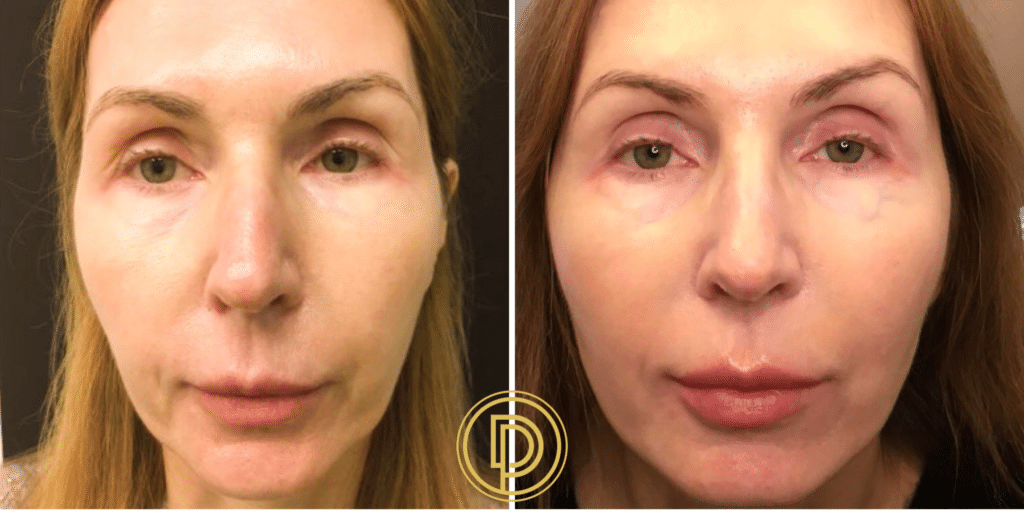
Scuptra Before and After

Why Do Forehead Lines Develop?
Every time you raise your eyebrows, the frontalis muscle contracts and folds the skin above it. When we are younger, those lines typically disappear as soon as the forehead relaxes. With years of repeated movement, along with collagen loss, sun exposure, genetics, and normal skin aging, the creases can become more noticeable and eventually remain visible even when your face is at rest.
This distinction between dynamic and static wrinkles matters when choosing treatment. Dynamic wrinkles appear or deepen with facial expression. Static lines remain visible when the muscles are relaxed.
If muscle movement is the primary cause, treating the movement itself usually makes more sense than trying to add volume beneath the wrinkle.
What Does Sculptra Actually Do?
Sculptra is different from both neuromodulators such as Botox and traditional hyaluronic acid fillers. Its active ingredient, poly-L-lactic acid (PLLA-SCA), stimulates your body to produce collagen. As those new collagen strands gradually develop, they help restore support and improve skin structure.
This process takes time. Sculptra is not designed to create an immediate change after injection. Its appeal is the gradual nature of the improvement, which is why we often use it when a patient wants broader, natural-looking rejuvenation rather than correction of a single expression line.
Our Sculptra Dallas treatments are particularly useful for concerns such as facial volume loss, hollowing in the temples, changes in the cheeks and lateral face, and declining skin quality. Dallas Dermatology Partners also uses Sculptra as part of a larger approach to collagen maintenance and facial rejuvenation.
So, Does Sculptra Work for Forehead Wrinkles?
Sculptra stimulates collagen, and collagen loss is one factor in skin aging. However, that does not make Sculptra the best treatment for every wrinkle.
For the typical horizontal lines created by repeatedly raising the eyebrows, we generally prefer a neuromodulator such as Botox or Dysport. These treatments temporarily reduce the muscle activity responsible for repeatedly folding the skin. Dallas Dermatology Partners specifically uses Botox for horizontal forehead creases and other expression-related wrinkles.
Sculptra serves a different purpose. We may use it elsewhere in the upper face—particularly where loss of structural support or volume is contributing to an aged appearance—as part of a more comprehensive rejuvenation plan.
This is an important distinction because our goal is not to make Sculptra fit every concern simply because it is an effective injectable. We want to use the treatment that makes the most sense for what is actually causing the change you see.
What Is Better for Forehead Lines?
Botox or Dysport for Dynamic Forehead Lines
For lines that become more pronounced when you raise your eyebrows, Botox or Dysport is usually the more direct approach. These neuromodulators temporarily relax targeted muscle activity so the overlying skin does not crease as strongly.
Placement and dosing matter. The goal is not necessarily to eliminate every bit of forehead movement. Our dermatologists take your anatomy, existing lines, eyebrow position, and natural expressions into account when developing a treatment plan.
What About Deeper Lines That Are Visible at Rest?
A forehead line that has become etched into the skin may not disappear completely simply by reducing muscle movement. In these cases, we may discuss additional treatments designed to improve skin quality, texture, or collagen.
The right approach depends on the depth of the lines, your skin, previous treatments, and the overall pattern of facial aging. This is where having access to multiple injectables in Dallas and other cosmetic dermatology treatments becomes useful: we are not limited to trying to make one product solve every problem.
Where Can Sculptra Fit Into an Upper-Face Treatment Plan?
While we generally would not use Sculptra as a direct substitute for Botox in the forehead, it can complement an overall facial rejuvenation plan.
For example, aging in the upper face may include forehead lines and hollowing through the temples or loss of support elsewhere in the face. Treating only the forehead lines may improve one concern without addressing the broader changes contributing to an aged or tired appearance.
Sculptra can gradually stimulate collagen and restore support in appropriately selected treatment areas, while a neuromodulator addresses wrinkles caused by muscle movement. The two treatments are doing different jobs.
That is how we think about combination treatment at Dallas Dermatology Partners: not as doing more for the sake of doing more, but as selecting the right treatment for each concern.
Why See a Dermatologist for Forehead Wrinkles?
The forehead is a highly expressive part of the face, and small differences in injection placement can affect eyebrow position, movement, and overall facial balance. Treatment should take your individual anatomy into account.
Our board-certified dermatologists evaluate whether your forehead lines are primarily dynamic, deeply etched into the skin, related to broader changes in skin quality, or some combination of these factors. We can then recommend Botox or Dysport, Sculptra elsewhere in the face, another rejuvenation treatment, or a combination when appropriate.
Sometimes good cosmetic care is knowing which treatment not to use. We think that is just as important as knowing how to perform the treatment itself.
Find the Right Treatment for Forehead Lines
If forehead lines are bothering you, the answer may be Botox or Dysport rather than Sculptra, and that is an important distinction.
At Dallas Dermatology Partners, we do not start with a product and try to make your concern fit it. We start by looking at your skin, facial movement, anatomy, and goals. From there, we can determine where Sculptra may be beneficial and which treatment is best suited to your forehead lines.
Schedule a Dallas dermatology appointment with our board-certified dermatologists to develop a treatment plan that makes sense for you